

Autonomous Industrial Operations Platform – Context and Implementation

Piotr Szeląg

Industry and energy – especially asset-intensive and process industries – today operate under conditions of increasing operational volatility. Energy and fuel costs are subject to dynamic fluctuations, the structure of energy sources is becoming increasingly hybrid, and regulatory and ESG pressure is forcing organizations to manage efficiency, risk, and reliability with greater precision. At the same time, companies operate across complex OT environments – shaped by Industry 4.0 and IIoT adoption – composed of multiple control systems, historian systems, IIoT sensors, and analytical tools that have evolved independently over time.
In this environment, the ability to make fast and consistent operational decisions – increasingly powered by artificial intelligence and machine learning – is becoming a key factor of competitiveness. Decisions related to plant operation, resource balancing, responses to changes in demand, external conditions, and market prices have a direct impact on financial performance, security of supply, and the achievement of strategic goals. The scale of these decisions is increasing with the integration of energy storage, renewable generation, and new operating models.
The current model of operations management is based on distributed decision-making responsibility. Control systems execute assigned commands, analytical systems provide information and forecasts, while decisions remain fragmented across operators, procedures, and local practices. This arrangement makes it difficult to standardize, automate, and scale proven operating practices across the organization.
The Autonomous Industrial Operations Platform – an industrial data and decision platform built for IT/OT convergence – introduces a structured model for managing operational decisions, positioning it as a closed-loop supervisory layer between analytics and control systems. Its role is to orchestrate decisions, not to replace the existing OT infrastructure. The platform combines operational data, business context, and AI/ML-powered decision models into a single, coherent operating mechanism – effectively a knowledge and orchestration layer above the existing automation stack.
The foundation of this concept is the formalization of operational decisions. Each decision is described through a defined set of input data, optimization objectives, boundary conditions, and safety constraints. This makes it possible to clearly define the scope of autonomy – aligned with the industry-standard levels of autonomy (from manual and semi-automated through supervised autonomy to fully autonomous operations) – and the mode of supervision, while also enabling the gradual journey from industrial automation to industrial autonomy (IA2IA) as organizational maturity and trust in the system increase.
The platform operates continuously, using real-time data, historical data, and short-term forecasts such as demand, weather conditions, or energy prices. On this basis, it generates decisions or recommendations – supported by anomaly detection, predictive analytics, and root cause analysis – that can either be executed directly by control systems in a closed-loop mode or submitted for approval in accordance with the adopted responsibility model. Every decision and every action is recorded in a full audit trail, ensuring explainability and available for further analysis.
Architectural Approach
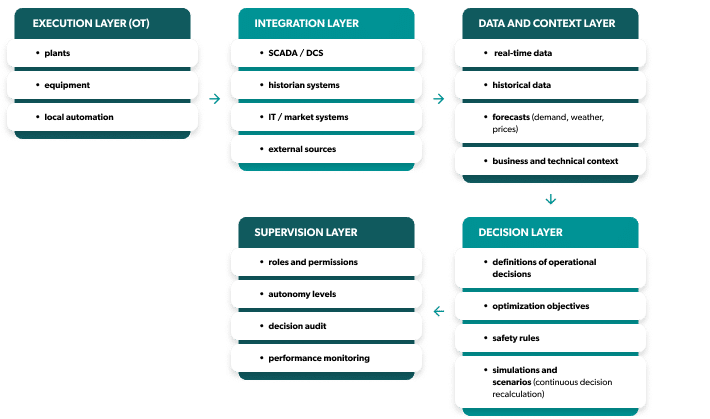
The architecture of the Autonomous Industrial Operations Platform is based on a layered model designed for OT environments and high operational availability.
The lowest layer consists of existing control and automation systems such as SCADA, DCS, local PLC systems, and IIoT sensors – together forming the cyber-physical foundation of the plant. The platform does not interfere with their native control logic (including any existing MPC/APC loops); instead, it uses them as the execution layer for approved decisions.
Above that sits the integration layer, responsible for secure and efficient data acquisition from OT and IT systems – delivering the IT/OT convergence that MES and ERP alone cannot provide. It includes integration with historian systems, analytics platforms, external data sources, and business systems. This layer provides a consistent data model, data contextualization, and a single source of truth for operational context.
The central element of the architecture is the decision layer. It consists of a decision engine and a runtime environment for machine learning models, knowledge graphs, and operational rules. This layer is where real-time optimization logic, digital-twin-based scenario simulation, and enforcement of safety rules are executed – the core of closed-loop industrial decision-making. The decision layer operates continuously and is designed to support both real-time decisions and planning decisions.
Above the decision layer is the management and supervision layer. It enables the definition of roles, role-based access control (RBAC), and graduated autonomy levels, while also providing a full audit trail for decision-making – essential for governance and explainability in autonomous operations. This layer serves as the interface for business and operational users, enabling supervision of the platform’s operation without requiring intervention in its technical logic.
An architecture designed in this way allows for the gradual implementation of operational autonomy – progressing through the levels of autonomy from supervised recommendations to fully autonomous, zero-touch closed-loop operations – without risking destabilization of existing systems. It also enables the scaling of proven decision strategies across plants, locations, and organizational units, creating a consistent and predictable model for autonomous industrial operations and the broader journey of industrial digital transformation.
Proposed Architecture


Light mode